Firefighter Aptitude Study Guides: What to Use for Each Canadian Test

Last verified: November 20, 2026
Short answer: The best firefighter aptitude study guides are the ones written for the test you will actually write. Canada has no single firefighter aptitude test. Each department chooses its own: the FACT, the CPS, the NFST, the NTN FireTEAM, a test of its own or, in Winnipeg, a fire knowledge exam. So find out which test your department uses, start with the official study material for it, and practise the skills it measures. If your department doesn't name its test, study the skills its page lists. This guide gives the official material for each test, what it cost when we checked, how to judge any other guide, and a six-week study plan.
Some candidates search this phrase because a department told them to. Edmonton Fire Rescue Services' recruitment FAQ says: "You can find resources to help you study for the aptitude test by searching for 'firefighter aptitude study guides' online or accessing resources through your local library." If that's why you're here, the Edmonton details are under "What if the department doesn't name its test?" below.
What does a firefighter aptitude test measure?
An aptitude test measures skills you already have. It doesn't ask what you know about firefighting. The lists published for each test overlap a lot:
- Reading: understanding written information and applying it.
- Math: arithmetic and word problems. Calculators aren't allowed on the CPS exam, and FireTEAM math is done in your head.
- Map reading: routes, directions and locations on a street map.
- Writing: grammar, spelling and clear sentences.
- Mechanical aptitude: how simple machines, valves and water pressure behave.
- Listening: understanding and remembering information you hear.
- Human relations: teamwork, judgment and personal characteristics.
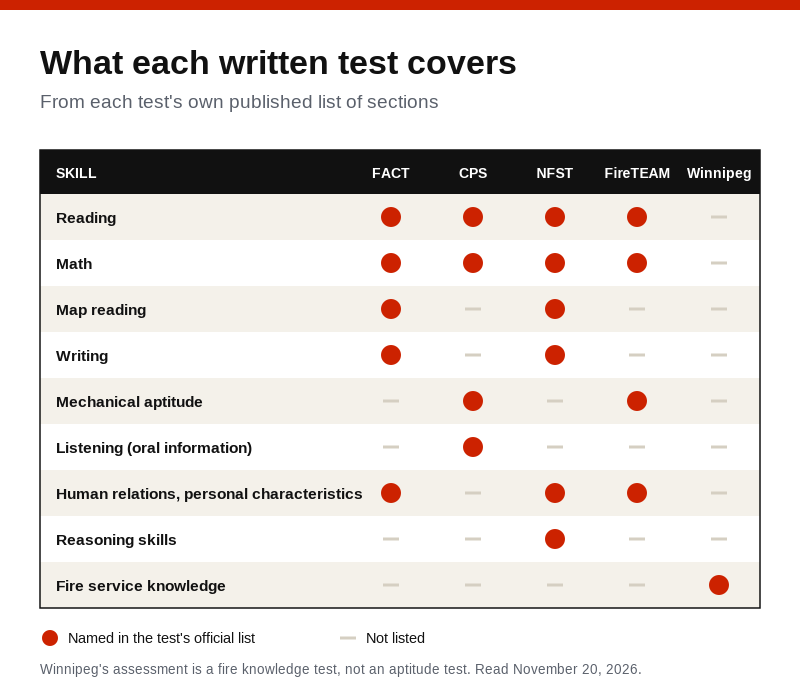
No test covers all of them. This table follows each test's own published list of sections.
| Skill | FACT | CPS | NFST | NTN FireTEAM |
|---|---|---|---|---|
| Reading | Yes | Yes | Yes | Yes |
| Math | Yes | Yes | Yes | Yes, on video |
| Map reading | Yes | Not listed | Yes | Not listed |
| Writing | Yes | Not listed | Yes | Not listed |
| Mechanical aptitude | Not listed | Yes | Not listed | Yes, on video |
| Listening (oral information) | Not listed | Yes | Not listed | Not listed |
| Human relations and personal characteristics | Yes | Not listed | Yes | Yes, on video |
| Reasoning skills | Not listed | Not listed | Yes | Not listed |
"Not listed" means the official page doesn't name that area. A department can add tests of its own, so read your posting. Winnipeg's written assessment isn't in the table because it tests fire service knowledge from a textbook, not aptitude.
Which firefighter aptitude tests are used in Canada?
FireStart has a free guide to each of these five written tests, and the comparison page sets them side by side.
FACT (Firefighter Aptitude and Character Test)
Ontario Fire Administration Inc. (OFAI) runs the FACT as Stage One of its candidate testing. OFAI lists 110 multiple-choice items in up to three hours: Reading Ability (15 items), Mathematical Reasoning (15), Map Reading (10), Writing Ability (10) and Personal Characteristics (60). The result is weighted 45% aptitude and 55% character. More in the FACT guide.
CPS (Cooperative Personnel Services exam)
Firefighter Services of Ontario (FSO) administers the CPS Firefighter Entry-Level aptitude examination. FSO lists four areas: understanding oral information, reading comprehension, mathematical ability and mechanical aptitude. You need at least 70 percent to pass. FSO doesn't publish the number of questions or the time limit. More in the CPS guide.
NFST (National Fire Select Test)
Fire & Police Selection, Inc. (FPSI) publishes the NFST. FPSI says it measures Reading Ability, Mathematical Reasoning, Map Reading, Writing Ability, Human Relations and Reasoning Skills, weighted 45% cognitive measures and 55% human relations and personality skills. FPSI doesn't publish a question count or a time limit. More in the NFST guide.
NTN FireTEAM
The National Testing Network (NTN) delivers the FireTEAM, which takes about two hours. It has four parts. The human relations and mechanical tests are shown on video. The reading test asks you to choose the word that best fits each blank. The math test is on video too, and no written calculation is permitted. NTN also has a second firefighter test, the Firefighter (Express) Exam, so check which one your department names. More in the NTN FireTEAM guide.
Winnipeg's Fire General Knowledge Written Assessment
Winnipeg Fire Paramedic Service (WFPS) sets a two-hour written assessment of fire service knowledge. Its application manual says the assessment is based on the textbook Fundamentals of Fire Fighter Skills. An aptitude study guide won't prepare you for it. More in the WFPS guide.
How do you tell which test your department uses?
- Read the department's own recruitment page or posting. It outranks every prep site, including this one. The departments directory links each department's recruitment page, and the Live Hiring Board lists open postings.
- Look for the name of the test, or of the organization that runs it. "OFAI Stage One" is the FACT. An FSO aptitude examination is the CPS exam. NTN delivers the FireTEAM and the Firefighter (Express) Exam. FPSI publishes more than one test, the NFST and the FACT among them, so look for the test's name as well.
- If the page names no test, write down the skills it lists. Then ask the recruitment office which study material it recommends.
Our city-by-city guide has what the larger departments' pages said when we checked them.
What if the department doesn't name its test?
Then study the skills it lists. Two Alberta examples:
- Edmonton Fire Rescue Services doesn't name its aptitude test, so we don't either. Its recruitment page, rewritten for the 2027 process, describes "A two-hour, 100-question, multiple-choice aptitude test" on four skills: reading and understanding written information, numerical skills, maps, diagrams and mechanical reasoning, and teamwork. Candidates in British Columbia, Alberta and Saskatchewan write it in person in Edmonton. Candidates from elsewhere can write it there or online with a proctor. It costs $75, and the page says "There are no test rewrites." Under "Test Preparation Resources (Optional)" it says: "Prepare for your test with official CPS HR study materials." It lists a preparation manual at $5 and practice tests at $15, bought from the vendor. The page also warns that "this process may change yearly", so read it again before you buy anything.
- Calgary Fire Department names a vendor but not a test: "National Testing Network (NTN) is the aptitude test vendor used by the CFD." Its page calls the test "a two-part exam that is taken online", with a fee of $55 USD. Calgary's resource list links the FireTEAM practice tests and free aptitude practice through the Calgary Public Library. The page doesn't say which NTN test candidates write, so confirm it when you're invited.
Official firefighter aptitude study guides, test by test
Start here. The organization that writes or runs a test knows what is on it. Prices are as each page listed them on November 20, 2026.
| Test | Official study material | Listed price |
|---|---|---|
| FACT | FPSI's FACT Candidate Orientation Guide, a practice test sold in two versions, B and C. OFAI says it has 40 multiple-choice questions. OFAI's own Stage One Pre-Assessment Guide explains the test day and is free to read online, but it has no sample questions. | $20.00 per version |
| CPS | FSO sells aptitude prep material. Its site says to contact FSO to buy it. | Not listed |
| NFST | FPSI's NFST Candidate Orientation Guide, a practice test in a single version. | $20.00 |
| NTN FireTEAM | The FireTEAM Video Practice Test on Ergometrics' practice site, which NTN's FireTEAM page points to. Each version includes two run-throughs of the same test. | Basic $24.99, Extended $38.99 |
| Winnipeg's knowledge assessment | The WFPS application manual, free on the City's careers page. It names the textbook and ends with a 10-question sample quiz and an answer key. | Free |
| Edmonton's aptitude test (not named) | The CPS HR preparation manual and practice tests listed on Edmonton's recruitment page. | $5 and $15 |
FPSI's and Ergometrics' pages don't state a currency. Calgary's resource list gives the FireTEAM practice test prices in U.S. dollars.
OFAI is plain about everything else on the market: "There are many third-party prep resources available, but OFAI only references the official FPSI orientation guide created specifically for the FACT™." That is the right way to treat any third-party guide, ours included. Use the official material to learn what the test looks like, and use other material for extra practice.
How to choose a firefighter aptitude study guide
Before you pay for a book, a course or a subscription, check six things.
- It is written for your test. Compare its contents with your test's official list of sections. A FACT candidate needs map reading and writing. A CPS candidate needs listening and mechanical aptitude. A FireTEAM candidate needs mental math and practice with video questions.
- It says where its facts come from, and when they were checked. Fees, pass marks and formats change. We found prep pages that give a question count and a time limit for the CPS exam, and FSO publishes neither.
- It explains every answer, including why the wrong options are wrong. A score alone doesn't teach you anything.
- It lets you practise under the test's conditions: timed, and without a calculator where the test bans one.
- It doesn't promise a pass or claim to have the real questions. Be wary of any guide that does either.
- It fits a Canadian test. Many of the guides that turn up in a search are written for city and state exams in the United States. They can still help with reading, math and mechanical practice, but check them against your test's sections first.
Two free places to look first: your public library, which Edmonton's FAQ and Calgary's resource list both point candidates to, and the official pages in the table above.
Where FireStart fits: we publish this guide and we sell practice for these tests, so hold us to the same six checks. FireStart is independent of OFAI, FSO, FPSI, NTN and every fire department. Our test guides are free to read. A membership adds practice questions with explanations and timed practice exams for the FACT, CPS, NFST, NTN FireTEAM and Winnipeg's assessment, plus lessons on the aptitude skills. Our FireTEAM practice is text, not video, so pair it with the official practice test.
A six-week study plan for a firefighter aptitude test
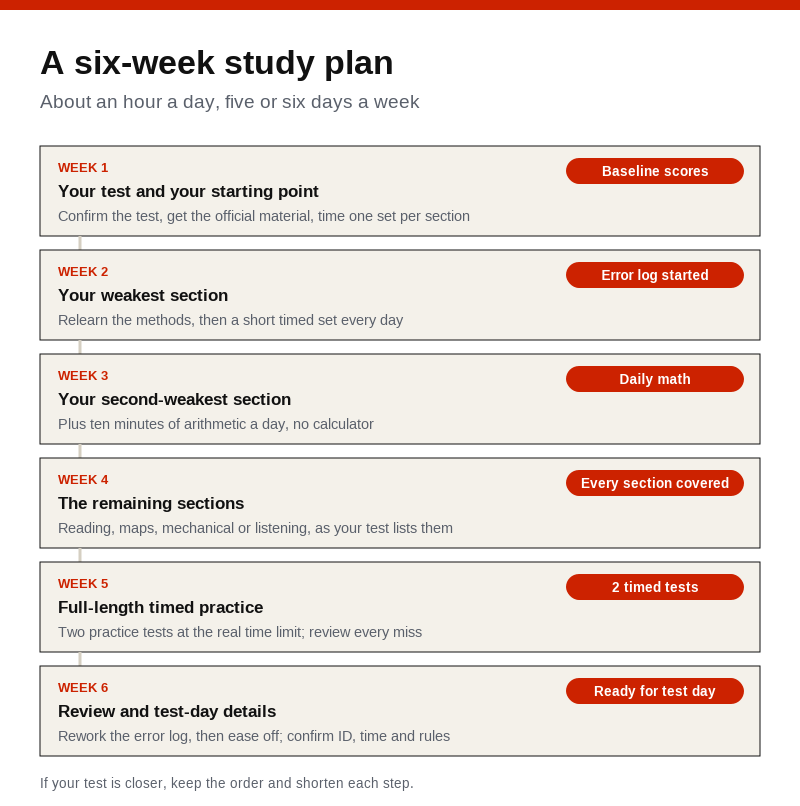
This plan assumes about an hour a day, five or six days a week. If your test is closer than six weeks, keep the order and shorten each step.
| Week | Focus | What to do |
|---|---|---|
| 1 | Your test and your starting point | Confirm which test you'll write and its sections. Get the official study material. Do one short timed set in each section before you study anything, and write down your scores. |
| 2 | Your weakest section | Relearn the methods, then do a short timed set every day. Start an error log: the question, why you missed it, and the rule you'll use next time. |
| 3 | Your second-weakest section, and math every day | Ten minutes a day of arithmetic without a calculator: fractions, percentages, ratios, rates and unit conversions. |
| 4 | The remaining sections | Work through whatever your test lists that you haven't covered: reading under time, map routes, mechanical principles, or listening sets played once with no pausing. |
| 5 | Full-length timed practice | Write two full practice tests at the real time limit, one of them the official practice test if your test has one. Review every miss and add it to the error log. |
| 6 | Review and test-day details | Rework the error log. Write one last timed test early in the week, then ease off. Confirm your ID, your start time, the rules and, for an online test, your computer and connection. |
Human relations and personal characteristics sections work differently. You can't memorize answers for them. Read how the official guide describes the section, and answer the way you would really act. For the FACT, see our free Personal Characteristics guide.
FAQ
What is the best study guide for the firefighter aptitude test?
The official guide for the test you are writing, plus timed practice in that test's sections. There is no single firefighter aptitude test in Canada, so there is no single best guide. Find your test's name on your department's recruitment page first.
Are there free firefighter aptitude study guides?
Some. OFAI's Stage One Pre-Assessment Guide is free to read online. Winnipeg's application manual is free and includes a 10-question sample quiz. Public libraries are worth a visit: Calgary's resource list links free aptitude practice through the Calgary Public Library. FireStart's guides to the FACT, CPS, NFST, NTN FireTEAM and Winnipeg's assessment are free to read. The official practice tests from FPSI and Ergometrics are paid.
Which study guide should I use for Edmonton's firefighter aptitude test?
Edmonton's pages don't name the test. Its FAQ says "Your literacy, numeracy and mechanical reasoning ability will be tested as part of an aptitude test." Its recruitment page describes a two-hour, 100-question, multiple-choice test on four skill areas and points to "official CPS HR study materials" as optional preparation. Start with those materials and with the skills the page lists, and email the recruitment office if you're unsure. Edmonton changed its process for 2027 and takes applications from January 1 to 31 each year, so read the page again before you apply.
Do American firefighter study guides work for Canadian tests?
The official ones do. FPSI's guides are for the FACT and the NFST wherever those tests are written, and the FireTEAM practice test is for the FireTEAM. General firefighter exam books are another matter. Many are written for city and state exams in the United States, so compare their sections with your test's before you rely on one.
How long should I study for a firefighter aptitude test?
No administrator publishes a figure. The plan above uses six weeks at about an hour a day. Give yourself longer if the test has no retake in that intake. Edmonton's page, for one, says "There are no test rewrites."
Can I use a calculator on a firefighter aptitude test?
Not on the CPS exam: FSO says "Cell phones, smart watches, and calculators are not permitted" and provides scrap paper. Not on the FireTEAM either: NTN says candidates "must complete the calculations in their heads." Winnipeg's manual bans calculators too. For any other test, check the official page, and practise without one to be safe.
Is an aptitude test the same as a fire knowledge test?
No. An aptitude test measures general skills and needs no firefighting knowledge. A knowledge test is based on a firefighting textbook. Winnipeg's written assessment is a knowledge test. Edmonton has both: its aptitude test comes first, and before a recruit class forms it sets a Threshold Knowledge Exam on study material it provides, the Essentials of Firefighting textbook for NFPA 1001 Level 1.
Sources
- City of Edmonton, Edmonton Fire Rescue Services recruitment FAQ (PDF)
- City of Edmonton, Firefighter Recruitment (the 2027 process, as the page read on November 20, 2026)
- City of Calgary, Firefighter Recruitment and its Resource List (PDF)
- OFAI, Stage One: Firefighter Aptitude and Character Test and Stage One Pre-Assessment Guide
- FPSI, Candidate Orientation Guides, NFST Candidate Orientation Guide and National Fire Select Test
- Firefighter Services of Ontario, Aptitude Examination and Services
- National Testing Network, Firefighter Testing with FireTEAM
- Ergometrics, FireTEAM Video Practice Test
- City of Winnipeg, Winnipeg Fire Paramedic Service careers (Application Manual, Firefighter and Firefighter Paramedic, January 2025)