The Firefighter Panel Interview in Ontario: What Departments Look For and How to Prepare Behavioural (STAR) Answers
Last verified: October 23, 2026
Short answer: Most of the Ontario firefighter recruitments we reviewed include at least one interview. Where the pages say who sits on the panel, it's fire service staff, Human Resources staff or both. Toronto's Operations Firefighter page says candidates take part in a panel interview "to assess their skills, abilities, traits and competencies". Innisfil's guide says its questions "are situational and behavioural based".
The best preparation has three parts:
- Learn the qualities your target department lists in its posting.
- Prepare true examples from your own experience.
- Practise telling each example clearly with the STAR method: Situation, Task, Action, Result.
What the departments say about the interview
The pages we reviewed are fairly open about the format. They don't publish their actual questions.
- Toronto Fire Services has a standing Operations Firefighter page and accepts applications only when a position is open (none was open when we checked on October 23, 2026). The page lists a "Panel Interview" stage "to assess their skills, abilities, traits and competencies". At the interview you'll need government-issued photo ID. Before it starts, you'll fill in a declaration form saying whether you know any panel members.
- Mississauga's hiring-process page (its linked firefighter posting had been filled when we checked) lists "behaviour/competency-based interviews". It says the panel "will consist of Mississauga Fire and Emergency Services and/or Human Resources personnel."
- Innisfil's guide for its early-2026 recruitment (hosted by FSO; interviews were scheduled for February 2026) says the questions "are situational and behavioural based" and will probe past experiences, firefighter core competencies and the town's core values. It says the panel "may consist of" fire management and Human Resources staff.
- The Niagara Falls recruitment guide (revised February 2026, hosted by FSO; applications for that recruitment closed April 26, 2026) sets out:
- a first interview with a Hiring Panel of senior fire officers and a Human Resources representative
- arriving 15 minutes early to answer a written question, with five minutes to write your answer
- bringing a criminal record check, or its status, to the first interview
- a CritiCall multitasking test on the same day as the first interview
- a second interview for applicants the panel selects, when two supervisory references are due
- Hamilton's full-time firefighter recruitment page (the recruitment was closed when we checked) lists an in-person interview. It warns that if you don't bring the required original documents and copies, "you will be disqualified from the process."
- Brampton's Req. 580 (open October 6 to 26, 2026) says, "Our recruitment process may be completed with video conference technology."
So don't assume a format. One department might hold a single panel interview, another might interview by video conference, and another might run two rounds plus a written question.
What panels are looking for
None of the departments we reviewed publishes its scoring guide. Many postings do list the qualities they want, and those are your best clues.
- Toronto's key qualifications, which candidates must meet, include community service involvement, customer service skills, the ability to work effectively under stressful conditions and the ability to work in a team.
- Hamilton says it wants people who "value and can demonstrate trust, honesty, integrity, compassion and empathy and teamwork."
- Mississauga's minimum qualifications include acting with integrity, solving complex problems, working in a team, showing "caring and empathy towards others", and maintaining "confidence and composure during stressful or traumatic situations". They also include managing stress and adapting positively to change.
- Brampton's Req. 580 lists similar beneficial skills, such as acting with integrity, sound judgment, teamwork, composure in stressful or traumatic situations, resilience, and a commitment to volunteerism, humanitarian or community service.
- Waterloo lists assets that include "demonstrated commitment to community service", strong communication and customer service skills, and the "ability to thrive in a team environment".
Hamilton's first step, FSO's Firefighter Entry Level Test, isn't an interview. It's a multiple-choice, video-based test. Still, the "common job stressors" it covers make good themes to prepare, including adaptability, communication, integrity/ethics, safety orientation and dealing with difficult situations.
Map your experience to these themes before the interview.
Behavioural vs situational questions
Government interview guides recognize several types of question. A Public Service Commission of Canada (PSC) interview-board guide names three: situational, behavioural and job knowledge questions. The Ontario Public Service's student interview tip sheet also covers general questions, such as "Tell me about yourself". Innisfil's guide says its firefighter interviews use two of these types: situational and behavioural.
- Behavioural questions ask about something you've done. The PSC guide says they rest on the idea that "the best predictor of future performance is past performance in similar situations." It tells interviewers to listen for the situation, the actions you took and the results.
- Situational questions set out a hypothetical scenario and ask what you would do. The PSC guide says they "present applicants with a hypothetical situation relevant to the position and ask how they would respond."
Also prepare a short, true answer to general questions, such as why you want to be a firefighter and why you want to join this department. The Ontario Public Service tip sheet suggests preparing a brief summary of who you are, what you've done and why that makes you a good fit for the job.
How to build STAR answers
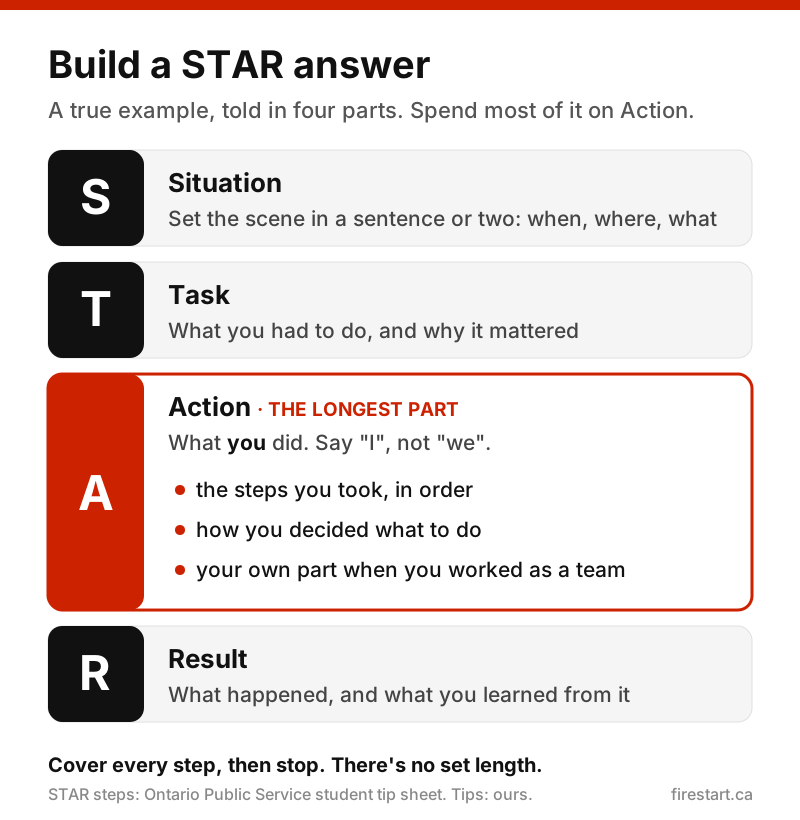
The Ontario Public Service tip sheet tells candidates to use the STAR method to talk through their experiences:
- Situation: set the scene. When and where, and what was going on?
- Task: what did you need to do, and why did it matter?
- Action: what did you do, and how?
- Result: what happened, and what did you learn?
Spend most of your answer on the Action.
The same tip sheet advises candidates to "emphasize your individual contributions" in examples of team or group work. That matters in fire service interviews, where so many examples involve a team. The panel needs to hear what you did.
When STAR doesn't fit: situational questions
Situational questions don't need a STAR story. Listen to the whole scenario. Then explain what you would do first, what you would do next and why, and who you would tell or involve. If the scenario reminds you of something you've done, you can draw on that experience, as the Ontario Public Service tip sheet suggests. Keep the focus on the scenario you were given. If you need a moment to think, take it.
Build an example bank
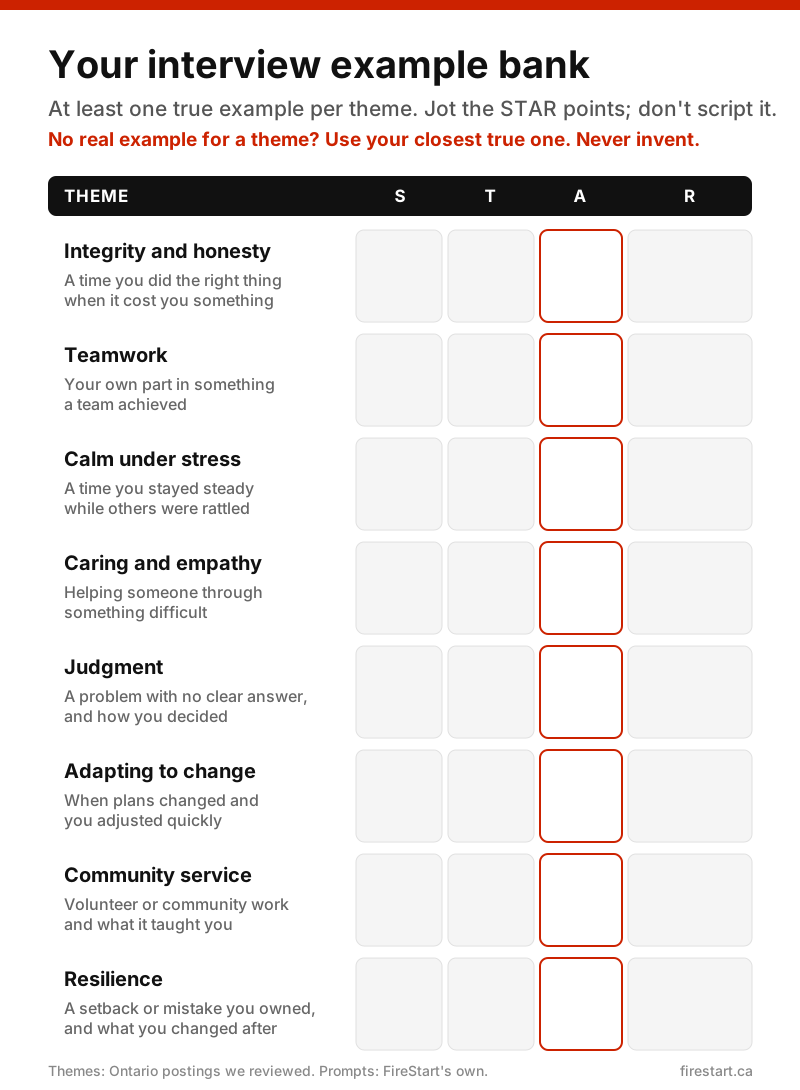
Before the interview, write out several true examples. Aim for at least one for each theme your target posting lists. One example can often cover two themes. Good sources include:
- work, especially customer service, trades or shift work
- volunteer and community service
- school or pre-service fire training
- sport and team activities
- times when something went wrong and you fixed it or learned from it
If you don't have a true example for a theme, use the closest true one you have, even a small one from school, work, sport or volunteering. Never invent or borrow a story. Panels may ask follow-up questions, and Toronto, Hamilton, Mississauga and Brampton all list integrity.
For each example, note the STAR points in a few lines. Don't write a script to memorize. Then practise telling each example out loud until you can cover each STAR point clearly without rushing or wandering. None of the departments we reviewed sets an answer length, so follow any timing the panel gives you.
Illustrative practice prompts
These are illustrative practice prompts we wrote for this article. They aren't questions from any Ontario fire department, and we don't know what any panel will ask.
- Behavioural: Tell us about a time you had to stay calm when others around you were stressed.
- Behavioural: Talk us through a time you disagreed with a decision made by someone in charge. What did you do?
- Behavioural: Give an example of when you made a mistake that affected other people. How did you handle it?
- Behavioural: Tell us about a time you helped someone in your community who was going through something difficult.
- Situational: You notice a teammate cutting a corner on a safety step. What would you do?
For the four behavioural prompts, check that your answer has a clear situation, a task, your own actions and a result. For the situational prompt, say what you would do and why, step by step, and who you would involve. If you've faced something similar, you can mention it briefly, but answer the scenario you were given. Never invent a past experience to fit a question.
Practical preparation checklist
- Re-read the posting. List every quality, competency and asset it mentions.
- Research the department. Read its official pages on community programs and the services it provides. For example, Waterloo's page notes that firefighters "are also active in community service, public education and continuing professional development."
- Prepare your documents. Bring exactly what the invitation asks for. Hamilton's page asks for the original and one copy of each listed document. Toronto's position page asks for government-issued photo ID.
- Plan for the format. Prepare for in person, video, or a written question, depending on what the department tells you.
- Practise out loud. Use a timer and ask someone to listen and give you feedback.
- Be honest. Panels may ask follow-up questions, such as what you did specifically, so use only examples you can expand on. Background checks come later in most of the processes we reviewed. Innisfil's guide lists reference checks, a criminal record check and a social media check, and Toronto's position page asks for "three employment references from previous supervisors."
Candidates often share their own interview experiences online. Treat those accounts as anecdotal. Formats and questions change from one recruitment to the next.
Where the interview fits in the process
In most of the processes we reviewed, the interview comes after screening and testing, and before conditional offers, medicals and background checks. Hamilton's page also lists a psychological assessment before its interview. One exception to the usual order: Niagara Falls asks for a criminal record check, or its status, at the first interview. See the full Ontario firefighter requirements checklist and the physical test comparison.
Many processes also include screening tests before the interview. Examples are the Personal Characteristics section of the FACT, covered in our free Personal Characteristics guide, and Hamilton's video-based FSO Firefighter Entry Level Test. For the written aptitude tests, see FireStart's guides to the FACT, the CPS exam (administered by FSO), the NFST (FPSI), NTN FireTEAM and legacy Gledhill-Shaw OS practice. You can also read our FACT preparation guide. For postings, see jobs and departments.
FAQ
Who sits on a firefighter interview panel in Ontario?
On the pages that say who sits on the panel, it's fire service staff, Human Resources staff or both. Mississauga says its panel includes fire service and/or HR personnel. Innisfil's guide says its panel may include fire management and HR staff. The Niagara Falls guide names senior fire officers and an HR representative.
Are firefighter interviews behavioural?
Some departments say so. Mississauga lists "behaviour/competency-based interviews", and Innisfil says its questions are "situational and behavioural based". The other pages we reviewed don't name a question type, so prepare for both kinds.
How long is the interview?
None of the departments we reviewed publishes a set length for its interviews. Check your invitation for the timing and any instructions.
Can I find the actual interview questions?
None of the departments we reviewed publishes its questions. Prepare true examples for the qualities the posting lists instead of trying to memorize answers.
Sources
- City of Toronto: Operations Firefighter (panel interview stage)
- City of Toronto: Applying to Toronto Fire Services
- City of Mississauga: Firefighter hiring process
- Town of Innisfil: Firefighter (Full-time) Recruitment Guide, hosted by FSO (PDF) (archived copy)
- City of Niagara Falls: Career Firefighter Recruitment Guide, revised February 2026, hosted by FSO (PDF) (archived copy)
- City of Hamilton: Full-time firefighter recruitment
- City of Brampton: Firefighter - Probationary (Req. 580, open October 6 to 26, 2026) (archived copy)
- City of Waterloo: Become a firefighter
- Ontario Public Service: Student Interview Tip Sheet (PDF)
- Public Service Commission of Canada: Structured Interviewing, Interview Board Guide (PDF)
- Public Service Commission of Canada: Appointment processes: how to conduct interviews