Firefighter Physical Tests in Ontario: OFAI ETT/FPAT vs FSO CPAT vs York University Fitness Testing
Last verified: October 23, 2026
Short answer: Ontario departments don't share one fitness test. The pages we reviewed name three separate systems:
- Ontario Fire Administration Inc. (OFAI): the Encapsulated Treadmill Test (ETT) in Stage Two and the Firefighter Physical Aptitude Job-Related Tests (FPAT) in Stage Three
- Firefighter Services of Ontario (FSO): the Clinical Assessment and the Candidate Physical Ability Test (CPAT)
- York: York University firefighter fitness testing
Results from one system don't automatically count for another. Each has its own expiry rules. Find out which test your target department names before you book anything.
Which test does your department want?
Here's what the pages we reviewed say, with each recruitment's status as of October 23, 2026:
- OFAI:
- Toronto's standing Operations Firefighter page asks for the OFAI Stage Two Hearing, Vision and ETT certificates and the Stage Three FPAT certificate, all "current and valid at time of posting closing date", plus a Stage One FACT certificate, which doesn't need to be current. Toronto's application page adds that all documents must be valid on the day you submit. No Operations Firefighter position was open on October 23, 2026.
- Waterloo's standing "Become a firefighter" page asks for all three OFAI stages. That covers more than the ETT and FPAT (see "Other OFAI tests a posting may name"). The page tells candidates to check the City's job opportunities page to find out whether it's hiring.
- FSO:
- Chatham-Kent's standing recruitment page asks for FSO certificates, including the Clinical Assessment and the CPAT. Its 2026 full-time recruitment took applications until September 17, 2026, and FSO's recruitment page gave invited candidates until October 25, 2026 to hand in their application packages.
- Hamilton's recruitment page sends candidates to FSO for the Clinical Assessment, CPAT and acrophobia test. On October 23, 2026, the page said recruitment was closed.
- York:
- Mississauga's standing hiring-process page lists a "York University Firefighter fitness assessment (scheduled by the City of Mississauga)". The firefighter job posting that page links to was marked as filled on October 23, 2026.
- Clarington's standing firefighter page says the municipality organizes York testing for the applicants it invites. The page gives no recruitment dates.
- OFAI or York: Brampton's Req. 580 (open October 6 to 26, 2026) listed OFAI Stage 2 "OR" York University Firefighter Fitness Testing, so either one met that requirement. The same posting also asked for NFPA 1006 Surface Water Rescue certification or a current OFAI Swim Test certificate. OFAI's Stage Two is made up of the Hearing, Vision and ETT assessments, and OFAI only lets you take the ETT after you've passed the FACT and the Hearing Assessment. The posting didn't say how to arrange York testing, so ask the City of Brampton.
This list covers only the pages we reviewed. For written-test differences by city, see Firefighter aptitude tests by city. You can also check our department pages.
OFAI: the ETT (Stage Two) and the FPAT (Stage Three)
OFAI generally runs Stages One to Three at FESTI (the Fire and Emergency Services Training Institute), 2025 Courtneypark Drive East in Mississauga. Toronto's and Waterloo's pages call OFAI's certificates CTS (Candidate Testing Services) certificates.
Encapsulated Treadmill Test (ETT)
The ETT is OFAI's aerobic fitness evaluation. It has two parts: pre-appraisal screening, then a progressive treadmill test that you do in OFAI's firefighting PPE (about 23 kg) while wearing a VO2 mask. You must already have passed Stage One (the FACT) and the Stage Two Hearing Assessment.
Screening includes:
- a medical questionnaire
- up to six readings of resting heart rate and blood pressure
If screening stops you, OFAI says this "is not considered a fail". It means you can't safely test that day. OFAI asks candidates to:
- avoid caffeine, energy drinks and alcohol for at least 12 hours before
- avoid large meals or large amounts of liquid within 2 to 3 hours of the test
- avoid all exercise within 4 hours of the test
- avoid intense exercise within 24 hours of the test
- be clean-shaven where the mask seals
OFAI's Stage Two Pre-Assessment Guide sets out four phases for the treadmill test:
- Phase One: five minutes at 3.5 mph (about 5.6 km/h) while the incline rises
- Phase Two: eight minutes at 3.5 mph on a 10% incline
- Phase Three: the incline goes to 15%, then the speed rises until you can't continue or the test is stopped for safety
- Phase Four: a required five-minute flat recovery
To pass, you must complete Phases One, Two and Four, at least 18 minutes in total. OFAI says your VO2 result doesn't decide the pass. Wear athletic clothing under the gear. You can't use your own PPE, except gloves where OFAI permits them.
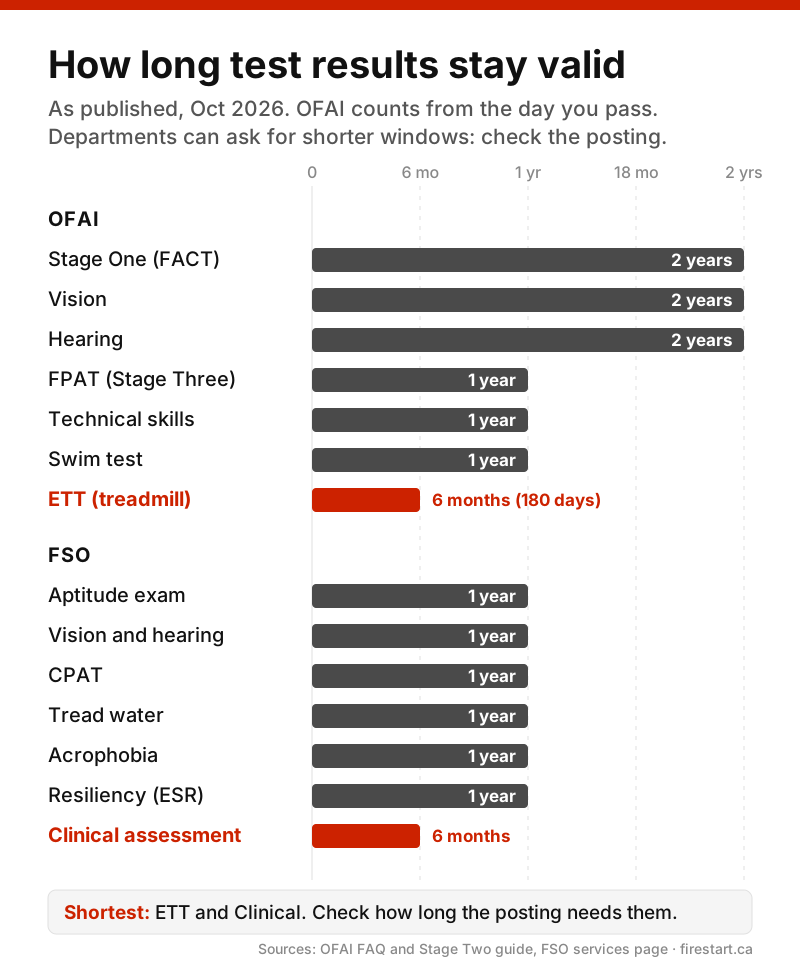
Validity: OFAI's FAQ lists the ETT as valid for six months from the date you pass, but its Stage Two Pre-Assessment Guide says 180 days. Plan on 180 days, the shorter of the two. That's the shortest window in the OFAI system. OFAI's FAQ also says you can't rebook a current assessment until the last 45 days before it expires.
FPAT
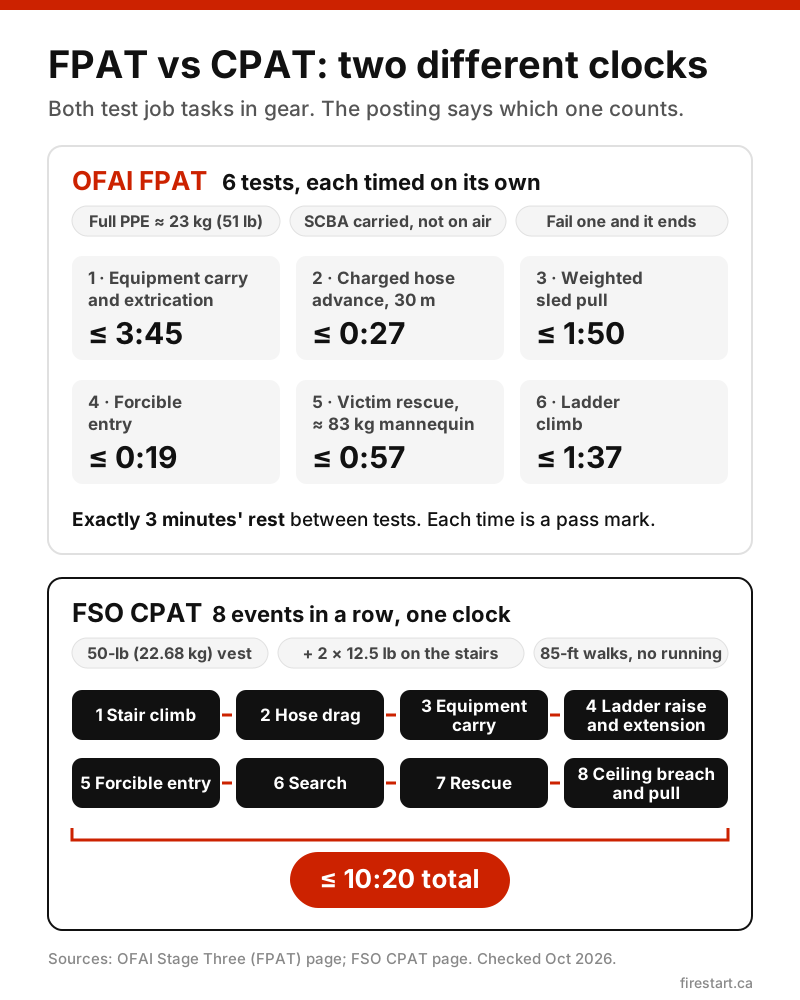
The FPAT is "six sequential job-related tests". You do them in full PPE that weighs "approximately 23 kg (51 lb)", carrying an SCBA but not breathing from it. OFAI provides the PPE; you can't use your own, except gloves that meet its criteria. A mandatory familiarization session comes first. You then get exactly three minutes of rest between tests, with your PPE on and without leaving the testing area. You must pass all six, and if you fail one, the assessment ends.
| OFAI FPAT test | Time standard |
|---|---|
| 1. Equipment carry / vehicle extrication | 3 min 45 s or less |
| 2. Charged hose advance (30 m, running not permitted) | 27 s or less |
| 3. Weighted sled pull | 1 min 50 s or less |
| 4. Forcible entry simulation | 19 s or less |
| 5. Victim rescue (mannequin approx. 83 kg) | 57 s or less |
| 6. Ladder climb | 1 min 37 s or less |
Validity: OFAI's FPAT page says one certificate "valid for 12 months". For fees, booking order and retest waits, see our OFAI candidate testing guide.
Other OFAI tests a posting may name
- Hearing and Vision Assessments: these are also part of Stage Two.
- Firefighter Technical Skills Assessment: this is also part of Stage Three. It has two sections of three skills, and each skill has a 10-minute limit. Section One includes a claustrophobia assessment, ropes and knots, and a 10 m ladder climb. Section Two includes roof operations, hose connections with a charged line advance, and a one-firefighter ladder raise. OFAI lists it as valid for 12 months once both sections are passed.
- Swim Test (Stage Four): OFAI runs it only when a municipal partner's recruitment needs one.
If a posting asks for all three OFAI stages, as Waterloo's does, plan on both Stage Three certificates (the FPAT and Technical Skills) and confirm with the department.
FSO: the Clinical Assessment and the CPAT
FSO's contact page lists its test sites in St. Catharines, with separate venues for the medical, clinical and aptitude tests, the CPAT and acrophobia tests, and the tread water test. Its mailing address is in Welland, and your booking confirmation email gives your appointment details. FSO lists seven testing components, and you're expected to know which ones a department requires before you register. FSO's recruitment page sets out booking steps and deadlines for each recruitment. It asks you to book all your tests in one appointment, and sessions are first come, first served. Outside recruitments, FSO runs open testing all year: practice sessions, and pre-qualify sessions in which passing all six tests in one day may pre-qualify you for recruitments within six months.
Clinical Assessment
The Clinical Assessment starts with pre-appraisal screening. It then has four scored tests:
- body composition
- maximal aerobic fitness (a graded treadmill test with a face mask)
- trunk flexibility
- a 60-second sit-up test
FSO says you must score "at least 18 points out of 30" and complete all five components to pass. It also says, "All Clinical Assessment test protocols are conducted once. Second attempts are not permitted." Its page lists these rules before the body-composition test, so that your body-fat reading is accurate:
- no exercise within 12 hours
- no caffeine within 12 hours
- no alcohol within 48 hours
- no food or drink other than water within 4 hours
- empty your bladder in the 30 minutes before your appointment
- no diuretic medications within 7 days. If you take a prescribed diuretic, talk to your doctor first. Don't stop a prescribed medication on your own.
FSO says you should be normally hydrated. At screening, you can't take the Clinical Assessment if your resting heart rate is over 100 beats per minute, or your blood pressure is over 144 systolic or 94 diastolic.
CPAT
FSO says its CPAT "consists of eight separate events":
- Stair climb
- Hose drag
- Equipment carry
- Ladder raise and extension
- Forcible entry
- Search
- Rescue
- Ceiling breach and pull
The test is pass/fail against a maximum total time of 10 minutes and 20 seconds. You also fail if you don't complete an event correctly, and some events allow only a set number of warnings. Between events you walk 85 feet (25.91 m), and "no running is allowed between events."
You wear a 50-pound (22.68 kg) vest throughout. Two 12.5-pound (5.67 kg) weights are added on your shoulders for the stair climb. FSO offers a virtual orientation and a practical orientation. It notes that completing the practical orientation does not earn a CPAT certificate.
If you fail your first attempt, FSO's FAQ says you can make one second attempt the same day, for an extra fee. No other FSO test can be repeated at the appointment.
Other FSO tests a posting may name
- Tread Water Test: 15 consecutive minutes, unassisted, staying vertical with your head completely above water. You fail if you touch the wall, ropes or anyone else, float on your back, go under or start swimming.
- Acrophobia Test: a 30-foot (about 9 m) ladder climb in a harness.
Validity: FSO's services page lists the CPAT as valid for one year and the Clinical Assessment for six months. It adds that departments "reserve the right to request different/shorter expiration lengths."
FSO's recruitment page also sets out a rule for candidates who completed the "core four" tests (Clinical, CPAT, Tread Water and Aptitude) in one day, on or after a cut-off date FSO sets for each recruitment. For a given recruitment, they may only need to redo expired components. Confirm your eligibility with FSO for the specific recruitment.
York University firefighter fitness testing
Mississauga names York testing and schedules it for candidates itself. Brampton's Req. 580 (open October 6 to 26, 2026) accepted York testing as an alternative to OFAI Stage 2. We couldn't find a York University page that sets out the protocol.
The only official description we found of what York testing includes is on the Municipality of Clarington's firefighter page. It says York testing includes medical evaluations (including hearing and vision tests), aerobic and physical fitness testing and swim testing. Clarington organizes a testing date at York for the applicants it invites, applicants pay for the testing, and Clarington says the results are valid for six months.
One detailed public account is an older, undated document titled "York University Firefighter Fitness Assessment", hosted on Mississauga's website. Its file properties show it was created in 2006, and Mississauga's hiring page doesn't link to it. Treat it as background only. That document lists:
- an aerobic fitness test on a treadmill using expired-air analysis
- eight job-related performance tests, such as a ladder climb, an enclosed-area search, a hose carry up and down five flights of stairs, and a rope pull
The University of Saskatchewan, which runs the York assessment for some Saskatchewan departments, currently describes the same eight job-related tests, plus medical screening and a treadmill test. Testing in Ontario may differ, so confirm the protocol with the department or scheduler that books your test.
OFAI vs FSO vs York at a glance
| OFAI | FSO | York | |
|---|---|---|---|
| Aerobic test | ETT (Stage Two): a graded treadmill walk in about 23 kg of PPE, passed by completing at least 18 minutes | Maximal aerobic fitness (part of the Clinical Assessment): a graded treadmill test to exhaustion in a T-shirt and shorts, scored on a 10-point scale | Aerobic fitness testing (Clarington); a treadmill test in the older document |
| Job-task test | FPAT: six timed tests, each with its own time standard | CPAT: eight events, one 10:20 total time limit | Physical fitness testing (Clarington); eight job-related tests in the older document |
| Validity (as published) | ETT 180 days (FAQ: six months); FPAT 12 months | Clinical six months; CPAT one year | Six months, per Clarington (we found no York University page on this) |
| Who books it | You, through your OFAI account | You, with FSO. For a recruitment, follow FSO's steps for that department: some have you book as soon as the recruitment opens, others (like Chatham-Kent in 2026) only after they invite you. FSO also runs open practice and pre-qualify sessions all year | The department: Mississauga schedules it, and Clarington organizes a testing date at York |
| Named on the pages we reviewed | Toronto (standing position page), Waterloo, Brampton (Req. 580, as one option) | Chatham-Kent, Hamilton (recruitment closed) | Mississauga, Clarington, Brampton (Req. 580, as one option) |
How to prepare (without guessing)
- Check your health first. Talk to a doctor before you start hard, weighted training if you have a medical condition, take medication or aren't sure you're ready, and build up gradually. If you answer yes to a question on OFAI's medical questionnaire or FSO's screening questionnaire, your physician must complete a clearance form before you can test. Both also check your resting heart rate and blood pressure on the day: OFAI's guides set a pass at 140/90 or lower with a pulse of 100 or lower.
- Start from the posting. Note which test it names, whether certificates must be current at closing, and any booking deadlines.
- Time your booking around expiry dates. The ETT (180 days) and the FSO Clinical Assessment (six months) have the shortest windows.
- Use the official preparation material. OFAI publishes Stage Two and Stage Three pre-assessment guides. FSO publishes event-by-event CPAT preparation advice and links the IAFF CPAT Candidate Preparation Guide. Read the rules for warnings and failures, not just how each event works.
- Follow the pre-test rules. OFAI says caffeine and alcohol can raise your heart rate and blood pressure enough to stop you at screening, and it won't accept a doctor's note in place of passing readings. FSO's food, drink and exercise rules are there so your body-composition reading is accurate.
- For the CPAT, practise linking events. FSO's guidance suggests that as your fitness improves, you begin to link the test components into one continuous workout. The FPAT works differently: each test is timed on its own, with exactly three minutes of rest between tests.
The physical test is one step in a longer process. See the full Ontario firefighter requirements checklist. When you reach the interview stage, see The Firefighter Panel Interview in Ontario.
Where FireStart fits
FireStart doesn't run or coach physical testing. Our guides focus on the written aptitude tests that often come alongside it: the FACT, the CPS exam (administered by FSO), the NFST (FPSI), NTN FireTEAM and legacy Gledhill-Shaw OS practice. For current postings, see jobs.
FAQ
Is the FPAT the same as the CPAT?
No. OFAI's FPAT is six tests, each timed separately with its own time standard. FSO's CPAT is eight events done in a row against a single total time of 10 minutes and 20 seconds. They're run by different organizations, and a posting will name the one it accepts. FSO allows one same-day second CPAT attempt, for a fee. A failed FPAT test ends that assessment, and OFAI's retest waits apply (15 days after a first failure).
Can I use an OFAI certificate for an FSO department?
Not unless the posting says so. Neither FSO department we reviewed offered an OFAI alternative: Chatham-Kent asks specifically for valid FSO certificates, and Hamilton's most recent recruitment (closed as of October 23, 2026) sent candidates to FSO. York departments can be just as strict: Mississauga's 2026 recruitment FAQ says the City won't accept OFAI certification. Some postings do offer a choice. Brampton's Req. 580 (open October 6 to 26, 2026) accepted OFAI Stage 2 or York testing.
How long are physical test results valid?
As published: OFAI's ETT lasts 180 days (its FAQ says six months) and its FPAT 12 months. FSO's Clinical Assessment lasts six months and its CPAT one year. FSO notes that departments may set shorter windows. Clarington says York testing results are valid for six months. Always check the posting's wording, such as "current and valid at time of posting closing date".
Where do I find York University testing details?
Ask the department that schedules it. Clarington's firefighter page gives a short overview: medical, aerobic and physical fitness, and swim testing, with results valid for six months. The most detailed accounts we found are an older document hosted by Mississauga and the University of Saskatchewan's page on the York assessment it runs, so confirm current details directly.
Sources
- OFAI: Stage Two Encapsulated Treadmill Test
- OFAI: Stage Two Pre-Assessment Guide
- OFAI: Stage Three FPAT
- OFAI: Stage Three Pre-Assessment Guide
- OFAI: FAQs (certificate validity)
- OFAI: How to Register
- FESTI: About FESTI
- Firefighter Services of Ontario: Services
- Firefighter Services of Ontario: Occupational Assessment (CPAT)
- Firefighter Services of Ontario: Clinical Assessment
- Firefighter Services of Ontario: Tread Water Test
- Firefighter Services of Ontario: Firefighter recruitment and open testing
- Firefighter Services of Ontario: Contact (test sites)
- Firefighter Services of Ontario: Recruitment
- Firefighter Services of Ontario: FAQ
- City of Mississauga: Firefighter hiring process
- City of Mississauga: Firefighter job posting (marked filled when checked, October 23, 2026)
- City of Mississauga: Firefighter Recruitment FAQ 2026 (PDF)
- "York University Firefighter Fitness Assessment" (older, undated document hosted by the City of Mississauga)
- University of Saskatchewan Human Performance Centre: York Firefighter Fitness Assessment
- Municipality of Clarington: Become a firefighter
- City of Brampton: Firefighter - Probationary (Req. 580, open October 6 to 26, 2026) (archived copy)
- City of Toronto: Operations Firefighter
- City of Toronto: Applying to Toronto Fire Services
- City of Waterloo: Become a firefighter
- Municipality of Chatham-Kent: Specialized recruitment
- City of Hamilton: Full-time firefighter recruitment