Firefighter Vision and Hearing Requirements in Ontario: Glasses, Contacts, LASIK and Colour Blindness, OFAI vs FSO

Last verified: November 22, 2026
Short answer: Ontario has no single provincial vision and hearing standard for career firefighters. The two big candidate testing services, Ontario Fire Administration Inc. (OFAI) and Firefighter Services of Ontario (FSO), both draw on the US National Fire Protection Association's standard, NFPA 1582, and each department can set its own. Here's what their pages said on November 22, 2026:
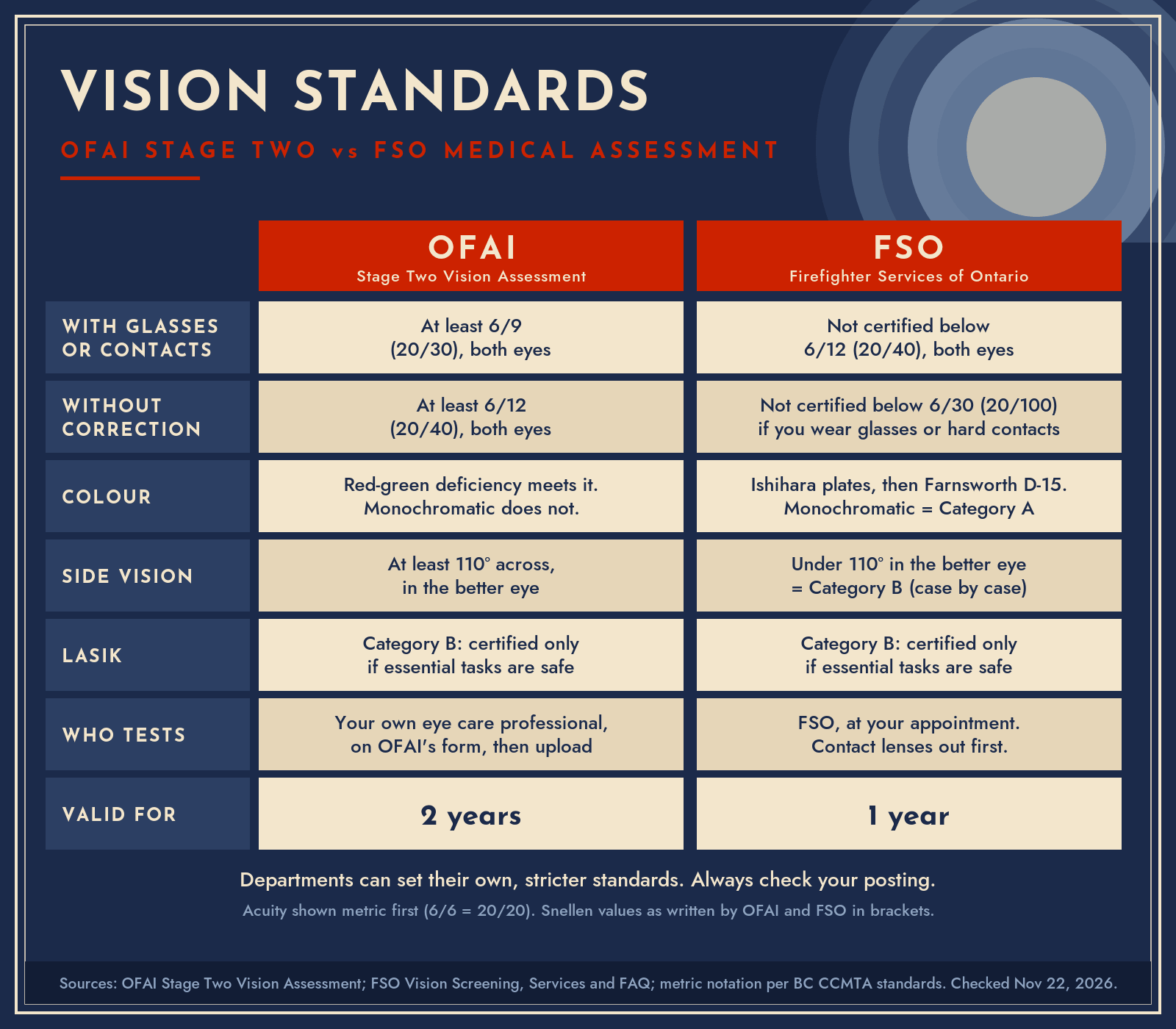
- Glasses and contacts are allowed, within limits. OFAI asks for 6/9 (20/30) with glasses or contacts, or 6/12 (20/40) without them, both eyes together. FSO asks for 6/12 (20/40) with correction, and glasses or hard-contact wearers must also see 6/30 (20/100) without them.
- Red-green colour deficiency doesn't fail you at OFAI. Monochromatic vision (seeing no colour) fails at OFAI and FSO. FSO checks with colour plates, then the Farnsworth D-15 test.
- LASIK isn't an automatic fail. Both list it as a "Category B" condition, judged case by case.
- Hearing is tested without hearing aids. Both use 40 decibels (dB) of hearing loss as the line, but OFAI applies it to each tone and FSO to averages.
- Some departments ask for more, such as "normal colour vision". Your posting has the final word.
This isn't medical advice. Ask an optometrist or hearing professional about your own eyes and ears, and confirm everything with the testing service and department before you pay.
Who sets the standard?
- NFPA 1582. OFAI's vision page says candidates "must meet the vision requirements outlined in Chapter Six of NFPA 1582". FSO says its standards "follow the recommendations of the National Fire Protection Association (NFPA)" and that "there is no comparable standard for Canada". We didn't read NFPA 1582 itself, so below is how OFAI, FSO and departments restate it.
- The testing service. OFAI's and FSO's versions aren't identical.
- The department. FSO says "some fire departments in Canada set their own medical standards, which may be different". OFAI says "department-specific standards still apply even where NFPA 1582 is used as guidance". When a department specifically asks, FSO tests to that department's own standard and issues a second certificate, but if you then apply somewhere with a different standard, "you will have to be retested to their standard".
Does one service accept the other's results? We couldn't find an official statement that they do. A posting can name the one it wants: Toronto names OFAI "CTS" certificates.
What "Category A" and "Category B" mean
- Category A: FSO says candidates with these "will not be certified as meeting the medical requirements of the NFPA standard".
- Category B: a candidate is certified "only if they can perform the essential job tasks without posing a significant safety and health risk to themselves, members, or the public" (OFAI's wording; FSO's is almost identical). It's case by case, so bring documentation from your eye or hearing professional if you have a listed condition.
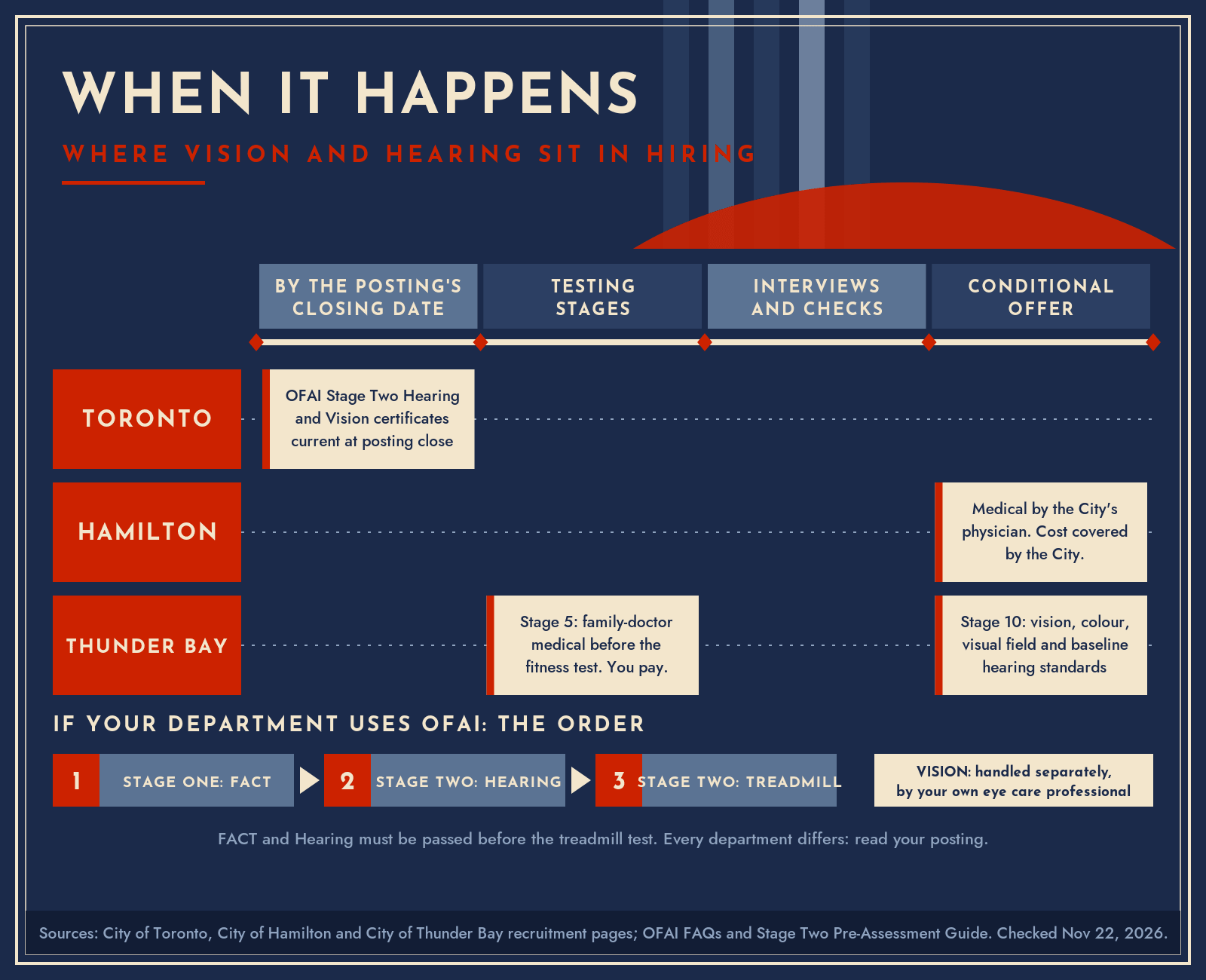
When does the vision and hearing check happen?
- Before you apply: Toronto. Toronto Fire Services asks for OFAI ("CTS") Stage Two Hearing and Vision certificates that are "current and valid at time of posting closing date". After a conditional offer, it also requires "a comprehensive medical examination conducted by the Chief Medical Officer for Toronto Fire Services".
- At the conditional offer: Hamilton. Hamilton lists its medical under "Required at Time of Conditional Offer". It's "administered by our physician", and "the cost of the medical assessment is covered by the City".
- Two medicals: Thunder Bay. In its 2025 process, Thunder Bay Fire Rescue wants "a medical by the applicant's family doctor" before the fitness test, paid by the applicant. Its conditional offer then depends on vision, colour vision and visual field standards, plus baseline hearing (audiometric) testing.
- Timing not stated: Mississauga. Mississauga Fire and Emergency Services lists "a medical assessment" among its hiring steps and says "some assessments will be at the candidate's expense": "approximately $500 for physical and/or medical assessments".
With OFAI, you must pass Stage One (the FACT written test) and the Stage Two Hearing Assessment before the treadmill test (ETT). The first Stage Two booking usually pairs Hearing with the ETT; Vision "is handled separately and is not part of this first-time bundle". Our OFAI testing stages guide walks through every stage.
Vision: the numbers side by side
Eye-chart scores are fractions. In metric, normal vision is 6/6 (20/20 in feet). A person with 6/12 (20/40) vision "needs to be 20 feet (6 metres) away to distinguish detail that a person with normal vision can distinguish at 40 feet (12 metres)", according to British Columbia's medical standards for drivers. OFAI and FSO write theirs in feet, so we show both.
| OFAI Stage Two Vision | FSO Medical Assessment | Hamilton (City page) | Thunder Bay (City page) | |
|---|---|---|---|---|
| With glasses or contacts | At least 6/9 (20/30), both eyes together | Not certified below 6/12 (20/40), both eyes together | At least 6/9 (20/30), both eyes together | "Best-corrected – stable" 6/12 (20/40) with both eyes, no less than 6/30 (20/100) in the worse eye |
| Without glasses or contacts | Or: at least 6/12 (20/40), both eyes together | Also needed for glasses or hard-contact wearers: not certified below 6/30 (20/100), both eyes together | Or: at least 6/12 (20/40), both eyes together | Also needed: "stable" 6/30 (20/100) with both eyes |
| Colour | Red-green deficiency meets the standard; monochromatic doesn't | Monochromatic vision "resulting in inability to use imaging devices" is Category A | "Normal… colour vision" | "Normal colour vision" |
| Side (peripheral) vision | At least 110° across, in the better eye | Under 110° in the better eye is Category B | Not stated | "Vision field testing" |
| Depth / both eyes | "Sufficient binocular vision" | Monocular vision is Category A | "Normal depth perception" | Not stated |
Read the first two rows together. At OFAI and Hamilton they're alternatives: meet either one. At FSO and Thunder Bay, glasses wearers need both. So someone who sees worse than 6/30 (20/100) without glasses but 6/9 (20/30) with them meets OFAI's acuity line and not FSO's.
Mississauga's page says to "meet the vision requirements of NFPA 1582" and gives no numbers.
Can I wear glasses or contact lenses?
Yes, within the limits above: "corrected" means with your glasses or contacts. If you rely on glasses, check the uncorrected line too: it's an alternative at OFAI and an extra requirement at FSO. Thunder Bay says "soft or RGP contacts, glasses/lens inserts are all acceptable".
- FSO says "candidates wearing contact lenses must remove them prior to the visual examination", so bring your case and solution, and ask FSO whether to bring glasses for the corrected reading. Its uncorrected line applies to "wearers of hard contact or spectacles".
- OFAI's vision check is done by your own eye care professional on OFAI's form, and its pages don't give contact-lens instructions. Ask your optometrist to fill in the form exactly as OFAI asks.
What about depth perception and one-eyed (monocular) vision?
OFAI asks for "sufficient binocular vision", meaning your two eyes working together, "to safely perform all essential job tasks", and lists amblyopia as a Category B example. FSO lists "monocular vision" as Category A, which isn't certified. Hamilton asks for "normal depth perception".
Is there a night vision test?
We couldn't find a night-vision standard on the OFAI, FSO, Hamilton, Thunder Bay, Toronto or Mississauga pages we checked.
Colour blindness: what actually fails
The two testing services draw the line in different words:
- OFAI: "Individuals with abnormal colour perception, including red-green deficiency, do meet the colour vision requirement. Individuals with monochromatic vision do not meet the requirement."
- FSO: the colour condition that fails (Category A) is "monochromatic vision resulting in inability to use imaging devices".
How FSO tests it: "Applicants are screened using colour plates on a Ishihara test for colour blindness. If the applicant fails this test the Farnsworth D-15 test is used." Someone who fails the Ishihara "can still pass the Farnsworth D-15". "A severe failure of the D-15 would indicate monochromatic colour vision" and a fail. FSO's pages don't mention red-green deficiency or say how a D-15 result short of a severe failure is treated, so if you have a strong red-green deficiency, ask FSO before you book.
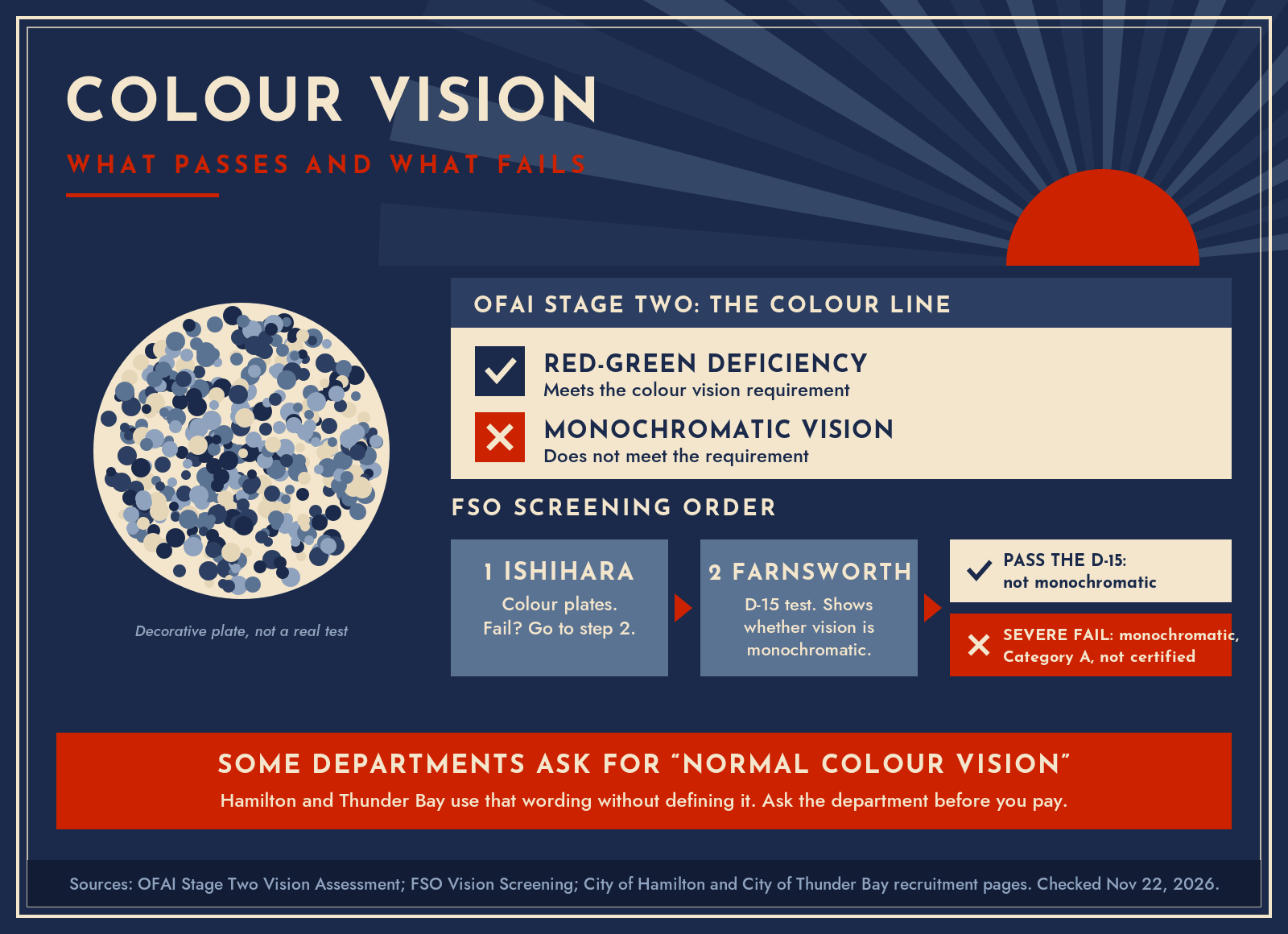
Departments can be stricter. Hamilton asks for "normal depth perception and colour vision" and "the ability to satisfactorily complete a colour vision test". Thunder Bay asks for "normal colour vision (testing with either Ishihara Colour Vision Test or the Farnsworth D-15)". Neither defines "normal", so ask the department in writing how it applies that line before you spend money.
LASIK, PRK and other eye surgery
Is LASIK a disqualifier? Not automatically. OFAI and FSO both list LASIK and radial keratotomy among the "ophthalmological procedures" that are Category B. You can be certified if you can do the essential job tasks safely.
PRK: Neither vision page names PRK. Both introduce their examples with "such as", so the lists aren't complete. Ask the testing service how it treats your procedure.
How long should I wait after surgery? We couldn't find a waiting period on the OFAI or FSO pages. Thunder Bay's acuity standard uses the word "stable". Ask your surgeon about your timing.
Hearing: the unaided test, in plain language
How OFAI tests hearing
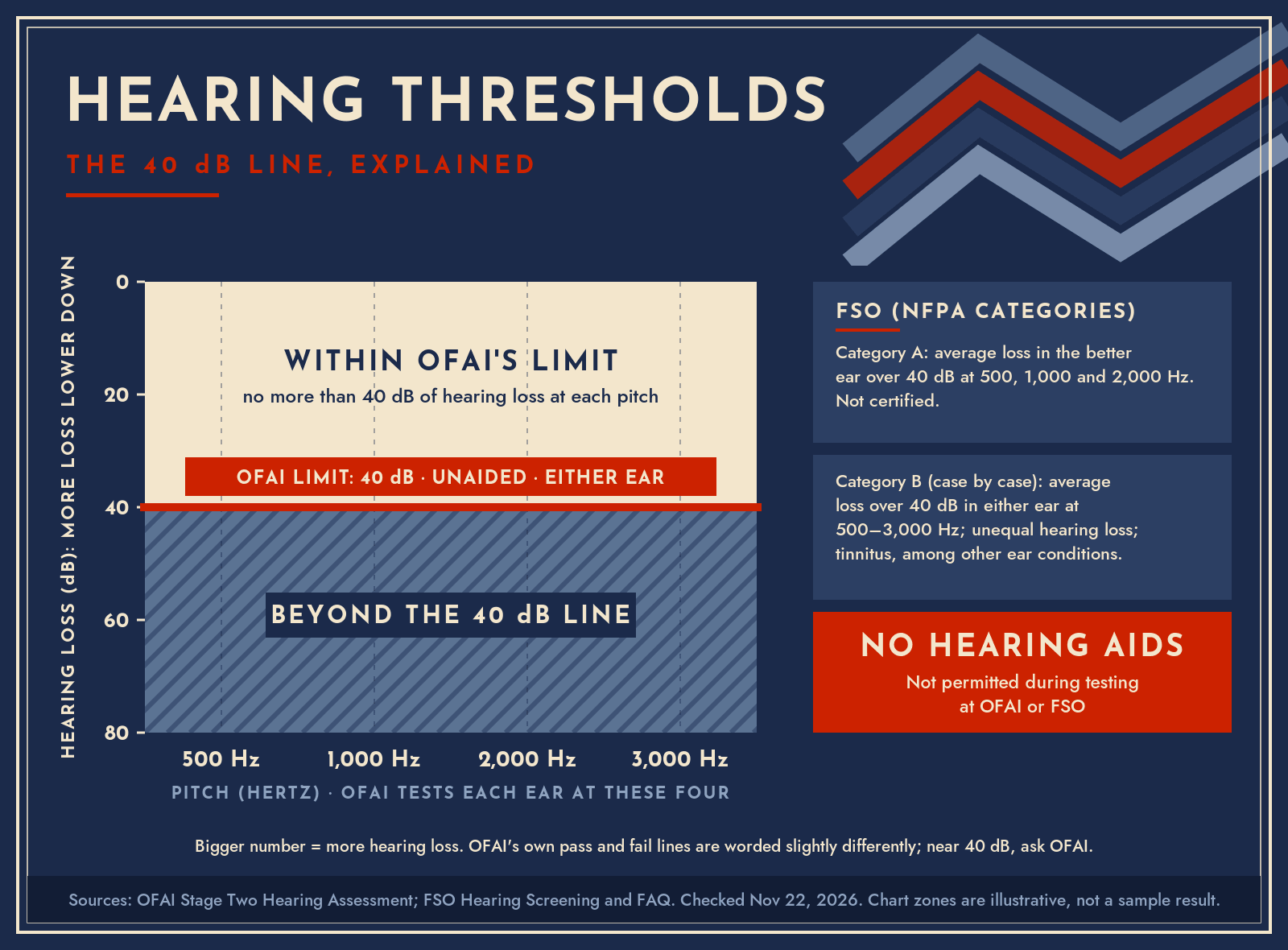
You sit in a soundproof booth and signal when you hear tones at different loudness levels and pitches. Loudness is measured in decibels (dB) and pitch in hertz (Hz). OFAI tests 500, 1,000, 2,000 and 3,000 Hz, each ear separately, and doesn't allow hearing aids or other assistive devices.
The standard: "Permitted hearing loss is no greater than 40 decibels, unaided, in either ear at 500 Hz, 1000 Hz, 2000 Hz, and 3000 Hz." Because it's written as hearing loss, a bigger number is worse. OFAI's Stage Two Pre-Assessment Guide spells out that the limit applies "in either ear at each tested frequency", so every tone has to be within it.
Inconclusive result? Ask Support for the referral form. It's due "no later than 15 business days following the original assessment". If the professional says you meet the standard, it's a pass. If not, it's a fail and "you cannot proceed with further testing" until you pass a retest (the waits are below).
How FSO tests hearing
FSO follows the NFPA categories, which use averages:
- Category A (not certified): "average hearing loss in the unaided better ear greater than 40 decibels (dB) at 500 Hz, 1000 Hz, and 2000 Hz", and "chronic vertigo or impaired balance as demonstrated by the inability to tandem gait walk".
- Category B (case by case): "Unequal hearing loss", an "average uncorrected hearing deficit at the test frequencies 500 Hz, 1000 Hz, 2000 Hz, and 3000 Hz greater than 40 dB in either ear", and conditions including "Meniere's syndrome, labyrinthitis, or tinnitus".
Can I wear hearing aids? What about tinnitus?
- Hearing aids: not for the test. FSO says "as per NFPA standards, hearing aids are not permitted", and OFAI doesn't allow assistive devices. Mississauga asks for "excellent hearing ability without the use of artificial aids".
- Tinnitus: FSO lists it as Category B. We didn't find it on OFAI's hearing page. Talk to a hearing professional and ask the testing service before you book.
Forms, who does the exam, and who pays
OFAI vision: download OFAI's form from your candidate account and take it to "an eye care professional of their choosing". OFAI charges no fee of its own for vision: you pay theirs, and "extended health benefits may be used where available". Upload the form as one PDF, stamped by the optometrist ("Do not attach a business card"); if there's no stamp, attach your paid receipt. Processing takes at least three business days, and problems show up as review notes in your account.
OFAI hearing: done on site at OFAI's testing facility in Mississauga. It costs $50.00 plus HST, according to OFAI's Stage Two Hearing page.
OFAI health questionnaire: OFAI also has a general medical questionnaire. If you answer "yes" to any question on it, a physician must complete the "Firefighter Candidate Testing – Medical Clearance Form" before testing.
FSO: vision and hearing are one component, the "Medical Assessment (vision and hearing)", taken at an FSO appointment and paid in full when you register. FSO's Services page lists it at $100, and says "candidates are expected to know the testing required by each department" before registering.
How long are results valid?
| Valid for | |
|---|---|
| OFAI Stage Two Vision | 2 years from the date passed |
| OFAI Stage Two Hearing | 2 years from the date passed |
| FSO Medical Assessment | 1 year from the date of issue, for departments that use the NFPA standard |
Departments can ask for more: FSO notes they "reserve the right to request different/shorter expiration lengths", and Toronto wants OFAI certificates current on the closing date. With OFAI, you can rebook a current certificate only in its final 45 days.
What if I don't pass? Retests and appeals
OFAI:
- Retest waits apply to each assessment separately: 15 days after a first failure, then 30 days after the second and every later failure.
- Feedback: after a failed assessment you can speak to a team lead; OFAI says "this is your only opportunity to receive feedback".
- Disputes: file one through OFAI's administration office within 14 days of the assessment.
- Vision paperwork: "incorrect documentation may require another visit to the optometrist and additional charges may apply".
FSO: "the only test that allows one 2nd attempt is the CPAT. No other tests can be repeated at the appointment". We couldn't find an FSO retest wait or appeal process on its pages, so ask FSO directly.
A five-minute check before you spend money
- Read the medical line in your target posting. Each department's FireStart page links its official sources, for example Hamilton Fire Department.
- Find out which testing service the department uses (OFAI, FSO or its own) and when the certificate must be current. Our Ontario requirements checklist covers the rest.
- With OFAI, get the vision form done early. Processing takes at least three business days.
- If you have a listed condition, ask first, in writing: LASIK, amblyopia, a colour deficiency, tinnitus or unequal hearing.
- Plan around the other tests. With OFAI, Hearing comes before the treadmill test. Our FPAT vs CPAT fitness test guide covers the physical side.
FAQ
Can I be a firefighter in Ontario if I'm colour blind?
Often, yes. Red-green deficiency meets OFAI's requirement. FSO fails monochromatic vision, which it checks with the Farnsworth D-15 after colour plates; ask FSO how it treats a strong red-green deficiency. Some departments, such as Hamilton and Thunder Bay, ask for normal colour vision.
Can I wear glasses or contacts?
Yes, within limits. OFAI accepts 6/9 (20/30) with glasses or contacts, or 6/12 (20/40) without. FSO asks for 6/12 (20/40) with correction, plus 6/30 (20/100) without glasses for glasses and hard-contact wearers, and has you remove contacts for the exam.
Do I need 20/20 vision without glasses?
Not at OFAI or FSO. At OFAI, 6/12 (20/40) without glasses is one way to pass; the other is 6/9 (20/30) with them. FSO also asks glasses and hard-contact wearers to see at least 6/30 (20/100) without them.
Does LASIK disqualify me?
Not automatically. OFAI and FSO list LASIK as Category B, decided case by case. We couldn't find a waiting period on their pages.
Can I wear hearing aids for the hearing test?
No. OFAI doesn't permit assistive hearing devices, and FSO says hearing aids are not permitted, as per NFPA standards.
What is the hearing standard?
At OFAI, hearing loss can be no greater than 40 dB, unaided, in either ear at 500, 1,000, 2,000 and 3,000 Hz. At FSO, an average loss over 40 dB in the better ear at 500, 1,000 and 2,000 Hz is Category A (not certified).
Who does the vision test, and who pays?
For OFAI, your own eye care professional fills in OFAI's form at your cost; extended health benefits may help. FSO tests both at its paid appointment. Hamilton's own physician does its medical, at the City's cost.
How much do the vision and hearing tests cost?
At OFAI, the Stage Two Hearing Assessment costs $50.00 plus HST. OFAI charges no fee of its own for vision: you pay your eye care professional's fee. FSO's Medical Assessment, which covers both, costs $100. Those were the listed prices on November 22, 2026.
What happens if I fail the OFAI hearing test?
If the result is inconclusive, you must contact OFAI for a referral form, due back within 15 business days. After a fail, you wait 15 days to retest, then 30 days after later fails. Disputes are due within 14 days.
How long are vision and hearing results valid?
OFAI's certificates last two years from the date you pass; FSO's Medical Assessment lasts one year. Departments can ask for shorter.
FireStart is independent and isn't affiliated with OFAI, FSO, NFPA or any municipality. This guide summarizes public pages and isn't medical advice. Standards change: confirm with the testing service and the department before you book.
Sources
All pages were checked on November 22, 2026:
- OFAI: Stage Two Vision Assessment, Stage Two Hearing Assessment, FAQs, Stage Two Pre-Assessment Guide, Medical Requirements
- Firefighter Services of Ontario: Medical Assessment, Vision Screening, Hearing Screening, Services, FAQ
- City of Hamilton: Full-time firefighter recruitment
- City of Thunder Bay: Fire Rescue, Fire Rescue recruitment
- City of Toronto: Operations Firefighter
- City of Mississauga: Firefighter hiring process
- Government of British Columbia (metric eye-chart notation): CCMTA Medical Standards, 22 – Vision impairments